

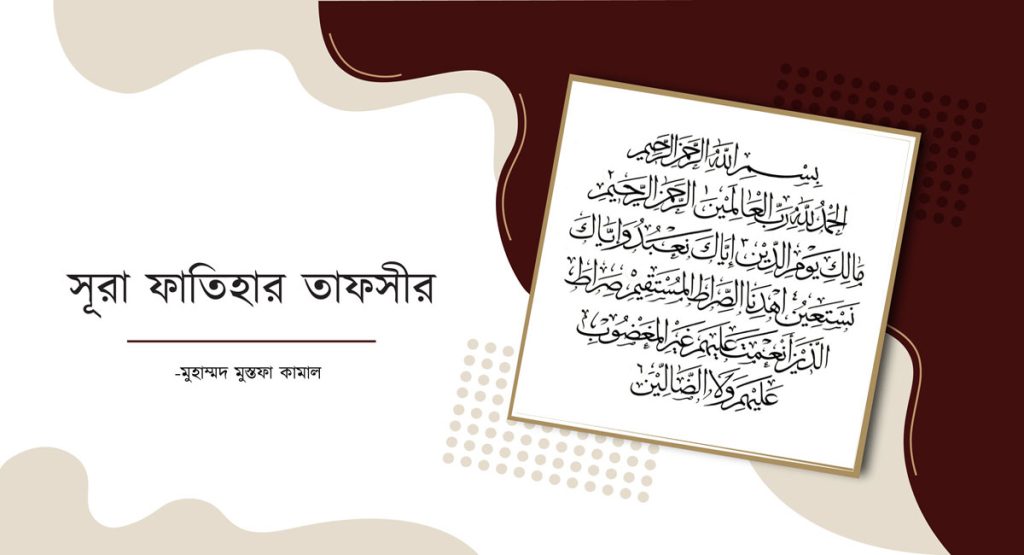
The chapters of the Qur’an that were revealed before the migration (Hijrah) of the Prophet Muhammad (peace and blessings of Allah be upon him) in 622 CE are known as Makki Surahs. In other words, the Surahs revealed during the 13 years of the Prophet’s life in Makkah are generally referred to as Makki Surahs.
The word Tafsir (تفسير) is derived from the Arabic root fassara–yufassiru (فسّر–يفسّر), meaning “to explain” or “to clarify.” The term is used for explaining and clarifying the meanings of the Qur’an.
The word Surah means a section or chapter. Since each Surah is a distinct part of the Qur’an, it is called a Surah. The word is also related to sur (سور), meaning a wall surrounding a city for its protection. Similarly, each Surah serves as a boundary distinguishing it from another Surah.
Virtues of Surah Al-Fatihah
Surah Al-Fatihah is one of the essential components of Salah, and Salah is not valid without it. It is narrated from Ubadah ibn al-Samit (may Allah be pleased with him) that the Messenger of Allah (peace and blessings of Allah be upon him) said:
“There is no Salah for the one who does not recite the Opening of the Book (Surah Al-Fatihah).”[1]
Imam An-Nawawi (may Allah have mercy on him) stated that this hadith clearly establishes the obligation of reciting Surah Al-Fatihah. For anyone who is capable of reciting it, Salah is not valid without its recitation. In another narration, the Messenger of Allah (peace and blessings of Allah be upon him) said:
“Every Salah in which the Opening of the Book is not recited is incomplete.”[2]
Surah Al-Fatihah is the most honored and greatest Surah of the Qur’an. No similar Surah of such distinction was revealed in any previous divine scripture.
Abu Hurairah (may Allah be pleased with him) narrated that the Messenger of Allah (peace and blessings of Allah be upon him) said to Ubayy ibn Ka‘b (may Allah be pleased with him):
“Would you like me to teach you a Surah the like of which has not been revealed in the Torah, the Gospel, the Psalms, or even in the Qur’an?”
He said, “Yes, O Messenger of Allah.”
The Prophet (peace and blessings of Allah be upon him) asked him how he recited in Salah. He then recited Ummul-Kitab, Surah Al-Fatihah, and said:
“By the One in Whose Hand is my soul, nothing like it has been revealed in the Torah, the Gospel, the Psalms, or the Criterion (the Qur’an). It is the seven oft-repeated verses and the Great Qur’an that I have been given.”[3]
Surah Al-Fatihah is the greatest Surah of the Qur’an because it contains the essence and central meanings of the Qur’an. For this reason, the Messenger of Allah (peace and blessings of Allah be upon him) described it as the greatest Surah of the Qur’an.
Abu Sa‘id ibn Al-Mu‘alla (may Allah be pleased with him) narrated that while he was praying, the Prophet (peace and blessings of Allah be upon him) called him. He completed his prayer before going to the Prophet. The Prophet then said:
“Shall I not teach you the greatest Surah in the Qur’an before you leave the mosque?”
He then taught him Surah Al-Fatihah and said:
“Al-Hamdulillahi Rabbil-‘Alamin (All praise is due to Allah, Lord of the worlds). These are the seven oft-repeated verses and the Great Qur’an that I have been given.”[4]
The Special Revelation of Surah Al-Fatihah
Surah Al-Fatihah is a great Surah whose revelation was accompanied by a special event. A door of heaven was opened, and a special angel descended with the Surah.
Ibn Abbas (may Allah be pleased with them both) narrated that while Jibril (peace be upon him) was sitting with the Prophet (peace and blessings of Allah be upon him), he heard a sound from above. He raised his head and said:
“This is a door of heaven that has been opened today. It has never been opened before today.”
An angel descended through it and said:
“This is an angel who has descended to earth. He has never descended before today.”
He then conveyed the glad tidings of two lights that had been given to the Prophet (peace and blessings of Allah be upon him), which had not been given to any prophet before him: Surah Al-Fatihah and the concluding verses of Surah Al-Baqarah.
The Prophet was told that whenever he recited even one letter from them, he would receive its reward.[5]
The Messenger of Allah (peace and blessings of Allah be upon him) repeatedly declared Surah Al-Fatihah to be the greatest Surah of the Qur’an.
Abdullah ibn Jabir (may Allah be pleased with him) narrated an incident in which the Prophet (peace and blessings of Allah be upon him) later taught him Surah Al-Fatihah and described it as the best Surah of the Qur’an.[6]
Anas ibn Malik (may Allah be pleased with him) also narrated that the Prophet (peace and blessings of Allah be upon him) described Al-Hamdulillahi Rabbil-‘Alamin as the best portion of the Qur’an.[7]
Surah Al-Fatihah Is a Makki Surah
Surah Al-Fatihah was revealed in Makkah. Surah Al-Hijr is also a Makki Surah, and it refers to the seven oft-repeated verses:
“And We have certainly given you seven of the oft-repeated verses and the Great Qur’an.”
(Al-Hijr, 15:87)
Hafiz Ibn Hajar Al-Asqalani (may Allah have mercy on him) mentioned that scholars differed regarding why it is called Al-Mathani (the oft-repeated). One explanation is that it is repeated in every Rak‘ah of Salah. Another view is that it is called so because Allah is repeatedly praised through it. Others have said that it is a special distinction granted to this Ummah that was not granted to previous nations.
Surah Al-Fatihah combines the praise, attributes and greatness of Allah with servitude and His oneness. It then presents the most important request and greatest aspiration of a believer: asking Allah for guidance to the Straight Path.
Therefore, when a caller to Allah calls people with these qualities, there should be no reason for that call to go unanswered.[8]
The Three Categories of Tawheed in Surah Al-Fatihah
Although Surah Al-Fatihah is short, it contains discussion of all three categories of Tawheed.
Tawheed ar-Rububiyyah—the Oneness of Allah in His Lordship—is reflected in:
“Al-Hamdulillahi Rabbil-‘Alamin”
“All praise belongs to Allah, Lord of the worlds.”
Tawheed al-Uluhiyyah—the Oneness of Allah in worship—is reflected in:
“Iyyaka na‘budu wa iyyaka nasta‘in”
“You alone we worship, and You alone we ask for help.”
And the Oneness of Allah in His Names and Attributes is reflected in:
“Ar-Rahmanir-Rahim, Maliki Yawmid-Din”
“The Most Compassionate, the Most Merciful, Master of the Day of Judgment.”
Thus, all three categories of Tawheed are included in this Surah.[9]
Surah Al-Fatihah as a Means of Healing
Surah Al-Fatihah encompasses both spiritual and physical healing.
Ibn Al-Qayyim (may Allah have mercy on him) explained that spiritual healing means complete healing of the heart. Diseases of the heart arise primarily from two sources: corruption of knowledge and corruption of intention. These produce two major diseases: misguidance and anger.
Misguidance results from corruption of knowledge, while anger results from corruption of intention. These two diseases are at the root of many other diseases of the heart.
Therefore, guidance to the Straight Path depends upon being protected from misguidance. Seeking this guidance is one of the greatest obligations upon every believer. It is for this reason that a Muslim asks Allah for guidance in every Rak‘ah of every Salah.
Because of the immense importance of this guidance, no other request is given priority over it.
Ibn Al-Qayyim (may Allah have mercy on him) explained that the verse:
“You alone we worship, and You alone we ask for help”
contains purification of the heart and intention concerning the knowledge of Allah, His actions and the servant’s relationship with Him.
Physical Healing
Physical healing also includes matters established through the Qur’an and Sunnah, medical principles and experience.
Abu Sa‘id Al-Khudri (may Allah be pleased with him) narrated that some Companions of the Prophet (peace and blessings of Allah be upon him) passed by a tribe whose chief had been bitten by a snake. One of the Companions recited Surah Al-Fatihah over him as a form of Ruqyah, and the man recovered.
When this was mentioned to the Messenger of Allah (peace and blessings of Allah be upon him), he approved of it and asked:
“How did you know that it could be used as a Ruqyah?”[10]
Ibn Al-Qayyim (may Allah have mercy on him) further mentioned his own experience of reciting Surah Al-Fatihah for pain and seeking healing through it. He also mentioned reciting it over Zamzam water and drinking it, describing benefits he experienced through it.[11]
However, such spiritual means should not be understood as a replacement for appropriate medical treatment. Rather, Muslims may seek permissible spiritual remedies while also taking appropriate worldly means of treatment.
Surah Al-Fatihah Refutes Misguidance
Surah Al-Fatihah also contains principles that refute the beliefs and arguments of misguided paths and religious innovations.
The Straight Path involves knowing the truth, giving it priority, loving it, following it, calling others toward it and striving against whatever opposes it within the limits prescribed by Allah.
The ultimate truth is the path upon which the Messenger of Allah (peace and blessings of Allah be upon him) and his Companions were upon. It includes correct belief concerning Allah, His Names and Attributes, His greatness, His Oneness, His commands and prohibitions, His promises and warnings.
This truth is the foundation upon which righteous deeds are built.[12]
In this sense, the essential meanings of the heavenly scriptures are reflected in Surah Al-Fatihah.[13]
The Most Beneficial Supplication
Surah Al-Fatihah contains one of the most beneficial supplications.
Shaykhul-Islam Ibn Taymiyyah (may Allah have mercy on him) stated that among the most beneficial supplications is the request for protection and healing from spiritual and physical ailments. He found this meaning in the verse:
“You alone we worship, and You alone we ask for help.”[14]
In summary, Surah Al-Fatihah is a key to the goodness and happiness of both this world and the Hereafter.
Ibn Al-Qayyim (may Allah have mercy on him) described it as the opening of the Book, the Mother of the Qur’an, the seven oft-repeated verses, a complete healing, a beneficial remedy, a comprehensive Ruqyah, a key to prosperity and success, a source of strength, and a means of removing anxiety, fear and distress for the person who understands its value, honors it and seeks benefit through it.
When some of the Companions understood its significance, they used it as Ruqyah for a person who had been bitten by a snake, and the person recovered immediately. The Prophet (peace and blessings of Allah be upon him) then asked:
“How did you know that it could be used as a Ruqyah?”
In short, Surah Al-Fatihah is a key to all goodness and a means of success in both worlds.
Ibn Al-Qayyim (may Allah have mercy on him) further explained that whoever is granted divine guidance and illuminated with insight can understand the profound meanings contained within this Surah. These include the Oneness of Allah, knowledge of His Essence, His Names and Attributes, His actions, His laws, His decree, His ownership of the Day of Judgment, His Lordship, reliance upon Him, praising Him alone, recognizing that all goodness is in His Hand, returning all affairs to Him, seeking guidance from Him, attaining the goodness of this world and the Hereafter, and being protected from their harms.
Understanding these meanings opens the doors of goodness and helps a person protect himself from the causes of harm.[15]
Conclusion
We should strive to understand the importance and significance of Surah Al-Fatihah. We should recite it in the five obligatory prayers and other voluntary prayers while reflecting upon its meanings and significance.
We should strive to develop deep concentration and sincerity in our worship of Allah. Most importantly, we should sincerely seek guidance to the Straight Path (Sirat al-Mustaqim).
May Allah grant all of us the ability to understand and follow the Straight Path. May He make us among those who follow the Straight Path and grant us goodness in this world and salvation in the Hereafter.
Ameen.
To be continued, Insha’Allah
Muhammad Mustafa Kamal
Lecturer (Arabic)
Barishal Government Model School and College, Barishal
References
[1] Sahih al-Bukhari, Hadith 756; Sahih Muslim, Hadith 394.
[2] Sahih Muslim, Hadith 395.
[3] Jami‘ at-Tirmidhi, Hadith 2875; Sunan an-Nasa’i, Hadith 11205; Musnad Ahmad, Hadith 9345.
[4] Sahih al-Bukhari, Hadith 4474.
[5] Sahih Muslim, Hadith 806.
[6] Musnad Ahmad, Hadith 17597.
[7] As-Sunan al-Kubra of An-Nasa’i, Hadith 8011; Ibn Hibban, Hadith 774; Al-Mustadrak of Al-Hakim, Hadith 2056.
[8] Madarij as-Salikin, 1/24.
[9] Madarij as-Salikin, 1/24–27.
[10] Madarij as-Salikin, 1/52–55.
[11] Madarij as-Salikin, 1/58.
[12] Madarij as-Salikin, 1/58.
[13] Madarij as-Salikin, 1/74.
[14] Madarij as-Salikin, 1/74.
[15] Zad al-Ma‘ad, 4/318.
Source: Monthly Al-I‘tisam